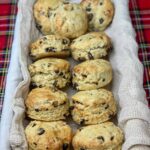
Edinburgh Fruit Scones
Servings: 6
Calories: 311kcal
Edinburgh Fruit Scones are an old-fashioned Scottish bake that originates in the beautiful capital city of Scotland: Edinburgh. Soft, crumbly, and sweetened with delicious dried currants these scones are perfect to enjoy with a nice cuppa tea. These scones are naturally egg-free and can be easily prepared as vegan-friendly by using dairy-free milk but you can use your usual milk.
Print Recipe
Equipment
- Measuring jug
- mixing spoon
- sieve
- Mixing bowl
- cutlery knife or spoon
- Baking tray plus parchment paper to line
- Biscuit/cookie cutter about 7cm diameter
Ingredients
For the buttermilk
- 250 millilitres milk [we use soya or oat milk but any milk will do so you can use your usual milk, use extra if required]
- 1 teaspoon apple cider vinegar [or white distilled vinegar, or lemon juice]
Basic scone recipe
- 285 grams self-raising flour [plus extra as required]
- 2 teaspoons baking powder
- 2 tablespoons caster sugar [or granulated]
- 57 grams margarine [use one suitable for baking, we used Stork baking spread]
- 1 pinch salt
- 110 grams dried currants [dried currants are the traditional choice, but dried raisins, sultanas, cranberries or mixed dried fruit can be used]
Instructions
- Preheat the oven to 200°C Fan / 220°C / 428°F / Gas Mark 7.
Prepare the buttermilk:
- Add the apple cider vinegar or lemon juice to the milk and mix well. Set aside until needed or leave to sit for at least 15 minutes.1 teaspoon apple cider vinegar, 250 millilitres milk
Prepare the scones:
- Sift the flour and baking powder into a mixing bowl.285 grams self-raising flour, 2 teaspoons baking powder
- Stir through the sugar and salt.2 tablespoons caster sugar, 1 pinch salt
- Add in the margarine and using your fingertips rub the margarine into the flour until the mix looks like breadcrumbs.57 grams margarine
- Mix through the dried currants.110 grams dried currants
- Add a tablespoon of buttermilk at a time to the scone mixture, stirring well with a cutlery knife or similar.You may need between 8-10 tablespoons to achieve a dough.
- Once a dough has nearly formed tip the dough onto a floured surface and gently work it together to a ball. It may be slightly sticky but that's ok, just sprinkle extra flour over it.If it's too dry and crumbly wet your hands with a little of the leftover buttermilk and try form the dough ball. Or sprinkle some milk over the dough and work it into a ball.
- Gently pat the dough into a thick circular shape. For large scones pat down until the dough is about 1 inch high [2 ½ cm].For smaller scones pat down to about ½ inch thick [1½ cm].Measurements are just rough estimates so don't get too bogged down trying to achieve perfection!
- Dust the biscuit cutter with some flour, and gently stamp out scones being careful not to twist the cutter as you remove the scone, as this may result in a wonky rising scone. Although wonky rising scones are traditional and just as good!
- If you want taller scones then they will have to be quite tall going into the oven.
- Place the scones onto a floured baking tray or use parchment paper if necessary to prevent sticking.
- Lightly glaze the top of your scones with the leftover buttermilk. If you don't have much buttermilk left just use the drips or remnants left on the sides of your jug. A pastry brush is helpful here! But clean finger tips can also do the job!If you don't have enough buttermilk just use some milk.
- Bake on the middle shelf or one shelf under your highest shelf, for about 10-14 minutes. We used a fan oven so our smaller scones generally take around 10 minutes and larger scones about 12-13 minutes. Although as fan ovens tend to bake faster other ovens may take a few minutes longer.
- Scones will be ready when they smell lovely, have risen, are lightly golden brown and browned on the underside as well.
- Enjoy warm from the oven or once removed from the oven leave the scones to sit on the tray for 5 minutes before removing to cool on a cooling rack.
Notes
- Nutritional data is for guidance only and is not intended to be an exact calculation as ingredients vary.
- It's generally advised that fruit scones are best eaten the day they are baked. However I find that the flavour and texture of the scone can be better the next day. Scones will be good for up to 3-4 days.
- For staler scones just toast and spread with butter or margarine or re-heat in a hot oven for a few minutes and they will be as good as new.
- Scones cope well with being frozen for up to 2-3 months but possibly longer if well wrapped.
- Add any variety of dried fruit to your scones. Such as just sultanas or raisins. Or use a dried fruit mix such as the ones intended for Christmas cakes and puddings. Traditional Edinburgh scones would have used dried currants.
- Don't like dried fruit? You can omit and maybe add some grated lemon or orange zest for a citrusy scone.
- Love cherry scones? Add some chopped glacé [candied] cherries in place of the dried fruit.
- Edinburgh fruit scones are tasty for breakfast, mid-morning snack, afternoon tea or supper. Or anytime you fancy one.
- Fruit scones can be served with a wedge of cheese on the side for a rustic vintage lunch or snack. Add some grapes or cherry tomatoes. Lovely for a picnic lunch.
- Want to prepare a double batch? Simply double the ingredients, but only use 1 tablespoon of baking powder rather than 4 teaspoons as too much baking powder can affect the flavour.
- For an added fat-free scone you can replace the margarine with mashed banana. We have tested this and the scones have a lovely banana flavour but the texture of the scone is abit different but we still enjoyed them very much. Just use the same amount of banana as required for the margarine/butter and rub the banana into the flour mixture as you would the margarine.
- For a healthier flour you can replace half the self-raising flour with a plain spelt flour which works rather well for scones. We have also tested this recipe with half self-raising flour and half self-raising wholemeal flour and the results were very nice. However, do keep in mind that different types of flour will affect the rise and density of the finished scone.
Nutrition
Calories: 311kcal | Carbohydrates: 55g | Protein: 7g | Fat: 8g | Saturated Fat: 2g | Polyunsaturated Fat: 2g | Monounsaturated Fat: 3g | Trans Fat: 1g | Sodium: 232mg | Potassium: 197mg | Fiber: 3g | Sugar: 16g | Vitamin A: 452IU | Vitamin C: 1mg | Calcium: 176mg | Iron: 1mg
